
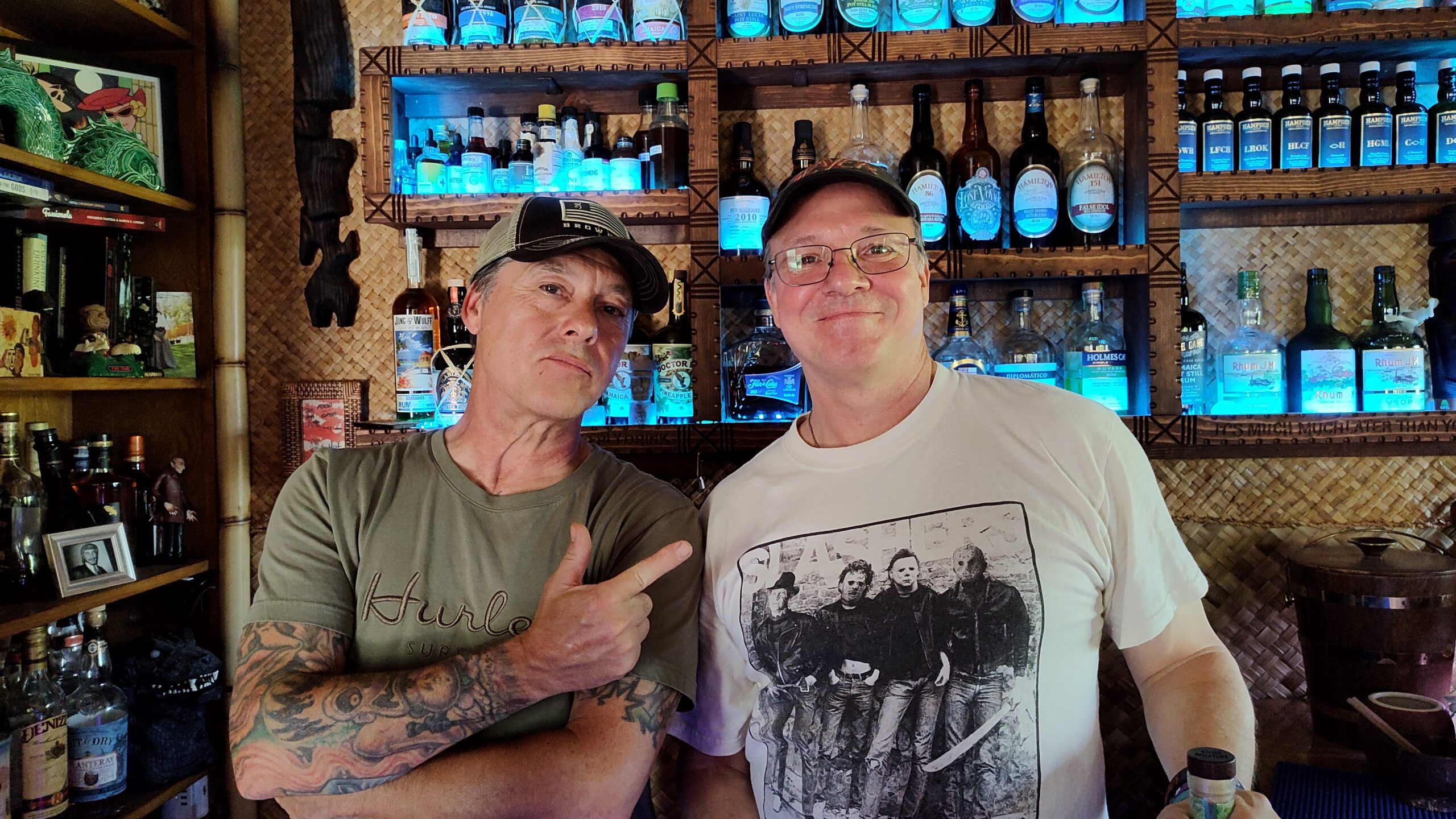
I’ve known Pinch for at least 10 years now, running in the same social circles. He graciously decided to come over to talk about his life and document many of the stories he’s told me in person at the many parties we’ve been to together. Pinch was a founding member of the English Dogs and played drums for the Damned for 20 years. He currently is playing with the all-star band, Spike & The Gimme Gimmes. This conversation happened on 7/21/25, two days before he headed out on another tour with Spike & The Gimme Gimmes (formerly Me First & The Gimme Gimmes).
I’m dividing this interview into 4 parts, each to be released on Tuesday for the next month.
In Part 1, we talk about his early life, learning to play drums, the formation of the English Dogs, and what the scene was like back in the early ’80s. But first, the most important question is asked…
Audio in the YouTube link below. Transcription is below that.
Ted: Okay, we’re with Pinch and we’re here to talk about stories and fun stuff, right?
Pinch: All the good stuff.
Ted: I do have to hit you up with a question that’s very, very important. You have a lot of history and all your bands and stuff like that, English Dogs, The Damned, Me First And The Gimme Gimmes, Janus Stark, and a lot of others. But let’s get to the most important question out of everything we’re going to talk about: You have a PS5. What video games do you have for it?
Pinch: Ah, so I’m a bit of a legendary tightwad. So when I found out that PS4 games could play on PS5, I started sourcing all the greatest PS4 games. I like first person shooters, racing games, that kind of stuff. I don’t really like these super duper open world games. I tried Dying Light and it was just, you know, endless jumping over shit and going on these side missions. And I was just like, it really ain’t for me. Give me something with a direct storyline. Shit, PS5. Ah… You put me on the spot.
Ted: I have to ask the important questions.
Pinch: Yeah, I know. I haven’t played it for so long. It’s one of those things that you crave. It’s like everything else, you know, consumer goods wise. You crave something for ages and you’re jealous that other people have got it. You get it, and then it just sits on your TV forever. You know me, I work all the frigging time at multiple jobs and and got multiple projects going on all the time. So when I do get a chance to play it, it’s kind of rough because you’re jumping back into a game where you have to remember all the moves, what it’s about, you know, the button combos and all that. That’s why I just like to jump into something and maybe even just replay some stuff. I mean, one of my favorites I played. I can’t even remember which platform it’s on is a game called Prey, which was just incredible. And obviously the Dead Space franchise. I just love that space horror kind of crap. You play it late at night with the lights off and there’s not much better that can take you out of the real world. And boy, do we need to get out of the real world as often as we can.
Ted: Let’s talk about your beginnings a little. I was at Extreme Noise Records in Minneapolis and there was a book on English punk and you’re mentioned on the first page. A lot of it is about you. And they mentioned how you were started off as a boxer. So you were like actually…
Pinch: Yeah, I was a rough kid. (laughs)
Ted: Yeah, but like a professional boxer, right?
Pinch: No, no. Amateur boxer. I started when I was eight years old. As a way… I think my parents threw me into it. Well, my parents got divorced when I was very young. So I was with my dad at the time and it was a way to try and keep me out of trouble. I went and fought for a club called Rugby Irish. And at eight years old, you’re not allowed to fight. You should be just training. But they threw me into the ring. “Oh, he’s all right. He’ll be all right.” And I lost most of my first few fights. And thankfully for me, they got scrubbed off of my record, because they found out I was too young to actually fight. So I think you have to be 10 or 11 or something like that to fight. So by the time I got to 11, I was obviously a lot better and then I could start fighting legally, if you like. It was around about that time, I moved back to live with my mum in Grantham in Lincolnshire. I was I was training five nights a week, and then fighting at the weekend. So I was always fighting. It was a great motivator. A great way to keep me out of jail, because I definitely would have been in jail more often than I actually was. And I kind of had a father figure in the trainer that I had as well. So he taught me a lot about life and a lot about morals and discipline. So it was a great learning experience for me. And obviously when I got introduced to punk rock, I already had hand-eye, four limb coordination, which transferred really easily from the boxing ring to the drum kit.
I stopped boxing because I got a mohawk, and it was before people were ready for it. It was still outrageous and shocking and like, “Oh my God. Look at this crazy kid.” And I started losing fights to kids that I’d beaten easily and kids that I’d beaten before. Like I was Midlands boxing champion, and I was like fighting way up in these tournaments. And decisions would go against me. And my trainer was just like, “Look, it’s the way you look. You’ve got to get rid of that stupid thing on your head.” I’m like, no! I just decided if even amateur boxing when you’re kids, is so heavily loaded and biased about the way you look, what’s the point in even doing it? It’s just bent. I used to fight in front of these, you know, dinner crowds where there was all these, you know, I don’t know what you call it over here, but in England, it was like, you know, Lions Club and Round Table. All these posh guys smoking cigars and, you know, drinking fine cognac and shit, and watching young kids beat the shit out of each other. So I thought, what’s the point? So I stopped that and it was about the time that punk rock for me in England was taking a bit of a dip. The first wave was gone and the remainder of the first wave was Stiff Little Fingers, UK Subs, those kind of bands. And I was actually putting on bus trips from Grantham. I was organizing coach trips to go and see these bands at local towns, because obviously nobody ever played in Grantham. And I would go and see them and I would be really disappointed. Like, Stiff Little Fingers were playing in spotted silk shirts and their songs were half tempo of what they were. It just didn’t seem real. And that coincided with the rise of the first UK hardcore punk. Discharge. GBH. Exploited. Crass. And I was like, oh, my God, this is where I’m at. Rudimentary Peni. You know, they were my absolute favorite favorites. My first ever show that I went to see was Discharge and GBH at Redford Port House in Nottinghamshire, about, I don’t know, 45 miles from our house or something.
Ted: What year? 1980?
Pinch: Possibly ’80? ’81, maybe? And I was like, oh, this is, this is ME. This is definitely ME. I’m like, all right, well, anybody can do this. I mean, listen to it. It’s just angry noise with not fantastic musicianship, but a shit-ton of passion. And they’re actually singing… not that Stiff Little Fingers… I’m not going to invalidate Stiff Little Fingers lyrics, because they’re massively important, you know, politically perfect. But of course, what we were all going through at the time, was Thatcher and Reagan. It was a really super scary time to be alive because she basically came to America and taught Reagan how to destroy the middle class. Like what she was doing in England. And it seemed like the nuclear threat was super real. And it could literally happen at any minute. So of course, we’re all like, you know, listening to all this doom and gloom in the news, listening to all the, you know, these incredibly depressing Discharge lyrics… which were kind of inspiring. Because we just wanted to write about the truth and what we were living in, and how we were feeling at the time. And that was the reality of how we were feeling.
So why I became a drummer was I decided to form a band and went and got the oldest punk in town. He was only two or three years older, to be the singer, because he looked big and intimidating. My mate, who I discussed the idea with, got a bass for Christmas off of his parents. So he was always going to be the bass player. And then we had, we hung around with this guy called Greg, this Scottish guy, tragic story, but he was a good lad, could kind of play guitar a bit. And we put this band together. Wakey, the lead singer, decided he wanted his mate, who was a giant football hooligan skinhead, to be the other singer with him. And we were going to be a two person frontman band. But unfortunately, Bonnie, his name is, I mean, he’s an amazing lad. I was actually in a band later on with him, which was kind of a forerunner of almost like Faith No More kind of sound, you know, but before they did it. Of course, nobody was interested in it because that music wasn’t around. And it was just like, “What is this? It’s just weird. We don’t like it.” So anyway, it was Wakey and Bonnie. Bonnie just really wasn’t up to it. His timing was terrible. His voice was weird, but kind of good. A great lyric writer. Basically, we decided to go, you know, just with Wakey because he was a commanding presence and an absolute natural lunatic. Then Watty was the bass player. Greg was the guitar player for a while. But he got really heavily into drugs, like heavy drugs when they weren’t super popular. And anyway, he was super unreliable. We decided to try and poach a guitar player from a local heavy metal band called Overdrive. John Murray. He was getting into the punk thing and he showed up to the first rehearsal with a flying V and we’re like, “Oh, no, you can’t have that fucking heavy metal guitar. No, no, no!” So he showed up to the next rehearsal. He chopped off one of the V’s and then driven a six inch nail through the other one. We’re like “Now that’s a punk guitar!” (laughter) So he was an incredible rhythm player and a really great songwriter. I’m not a guitar player, but I know he had a very unusual way of writing with the particular chords that he chose. And it was very catchy and his timing was fantastic. We all just gelled really well. So that that left me! As a drummer, by default. And I ended up very fortunately getting bought a drum kit for 60 quid by my parents and it was an old Premier Olympic white Marine Pearl kit that was like… it was in okay condition. It was a fairly low end kit.
And that was it. We were off. When I first started, all I would do to learn was kind of shuffle myself so that I could see how drummers played stuff on stage. Our first rehearsals with English Dogs, I was playing on oil drums with bamboo sticks. Even when I got a drum kit, I didn’t know… I didn’t get any lessons. I just looked at people. I didn’t even have a bass pedal. So we did our first gig upstairs at a pub in Grantham. I had my kick drum, or the legs were broken as well. So it sat on a pallet with the toms. And all of the stuff that I was playing was just toms. I don’t even know whether I had any cymbals. I might have had a cymbal. Can’t even remember. But that’s why I think a lot of the early English Dogs songwriting was very tribal. Because I didn’t have a kick pedal, and I was trying to make up for the sound of the kick pedal with the toms. And yeah, so it was by default, I became a drummer. And by default of me not having a kick drum pedal for a while, was probably modeling the way the early, early demo English Dog stuff went. So that’s that story.

Ted: I was going to ask what it takes to be a drummer. Timing, is that learned or is it a skill? But you already had the timing with the boxing.
Pinch: Yeah, I was very fortunate that I had that kind of drilled into me from, I don’t know, seven years in the gym and the ring. But looking back on it, I wish I’d have got lessons. Because I believe anybody can become a drummer. It’s all in you. You just don’t know it yet. And if you have the right people to teach you, like nowadays you can go online. You can go… I do it all the time… go to YouTube and pick a teacher that I like and scroll through a few lessons. Oh, that looks interesting. There’s some tribal tom rhythms that I’ve not tried. And let’s see if I can do them. So yeah, I think natural talent helps, but dedication helps a lot more. You really got to want to do it. And we really wanted to do it. Because we wanted to be on the stage with GBH and Discharge. And you know, fortunately, we ended up.
Ted: And you had nothing else. You had to.
Pinch: Yeah, nothing else. So we were living in a squat in Grantham, that we took over from that heavy metal band. They were paying rent, but we just moved in and never paid a bean to anybody of course. I mean, that place deserves a book on its own. It was above the high street in Grantham. So that’s like, you know, the main street in a city center, but it was a small town center. And we could just terrorize everybody from there. So it was like above a butcher shop that used to have a canopy out every day. And we would just like toss our trash out the window onto this canopy. So at the end of the day, the poor kid who was taking the canopy in would just get covered in whatever we tossed out of there, you know, chip, fat, anything. And the other place was called radio rentals where you could rent TVs and VCRs and all that kind of crap. And out the back of our flat, you had to go up these stairs to get to a flat roof, which was, which was above this radio rental shop. And we discovered it was all lead lined. And, you know, obviously you can get quite a bit of money for lead at the scrap merchants. So of course we robbed all the lead off the roof and they only found out the next time it rained and the showroom got flooded. And then they were stupid enough to replace it. We did it again. (laughter)
There was some genius at the flat, discovered that… we had a, we had an electric meter that took coins, like 50 pence coins. There were these like multi-sided coins. And you put your 50 pence in, turn this thing, the coin would drop into the box and it would give you however many hours of electric, right? So somebody discovered if you made 50 pence pieces out of ice, they were the same weight as the actual coin. So you put the 50 pence ice coin in, turn it around, it registers electric, the ice melts in the box. The guy would come like every month to empty the meter. There’d be like one 50 pence that was just like rusted. He’s like “All right. So what are you guys doing to get electric?” “Well, mate, we just use like candle power, you know, I mean, you know, we leave the curtains open. We’re pretty frugal.” Of course, we just like loading this thing. Hey, man, you have to be creative when you were a kid with no money. I mean, I used to pick vegetables in the fields at four o’clock in the morning to get any money. I mean, we used to go into pubs and walk around the pub. We used to call it minesweeping. If there was any unattended pint of beer, we would literally just walk up to it and drink it. Just down it and then leave the pub. And there was a lot of pubs. So you could get pretty drunk for absolutely nothing. We used to buy… or steal, these giant sacks of potatoes and just live on like mashed potato for months on end. That was it. You know, we just did what you had to do to survive. I was too young to claim any benefits. I was 15 when I was living in that squat. So, you know, we didn’t get any government benefit. It was just whatever you could beg, borrow, or steal to survive on.
Ted: And you were living in the squat because your parents were divorced?
Pinch: Yeah… And my mom had to move away from a psycho relationship. She literally had to escape and disappear. So I still had a year left at school. I was going to a really posh school in Grantham called the King’s School. And it was the same place where Sir Isaac Newton went. God knows what I was doing there, but anyway, I had my exams coming up. And I was actually in the band at the time. So we were going out and playing, you know, in Norwich with opening for UK Subs, then I was getting back at six o’clock in the morning, going to school at eight and taking my final exams. I mean, we were like… we would get virtually no money. It’s nothing’s really changed as the way support bands get paid. It’s still a pittance. But we literally couldn’t afford the gas, the petrol. So we just used to siphon from other cars into our tank to get us home after a gig. You know, we definitely drank plenty of gasoline in my time.
Ted: So English Dogs were your first band…

Pinch: English Dogs had a whole kind of first, second, third, fourth career, like a lot of people do. Different lineups. I mean, the first English Dogs, we were playing around the time where it was so violent at punk gigs, because of the rise of the National Front and football hooliganism, they all kind of melded together around the time of the, the Oi movement, which was championed by this bloke called Gary Bushel, who was a music journalist. And whether it’s right or wrong that he celebrated this kind of lad culture, or whether it got hijacked… it was just, you know… the gigs seemed like a training ground for gangs of hooligans and skinheads to come and beat the fuck out of the punk rockers that was there. It was a really, really horrible time to be playing gigs because you knew… I mean, stupidly, we were called English Dogs. They were like, “You’re called the fucking English Dogs! You can’t befucking right wing!” We’re like, “NO! We’re exactly the opposite of that!” We just mean that we’re like, you know, rough, tough and proud, you know, of being English and you know, the Dogs is more like, you know, the snarling sound of the music.
And they just couldn’t fucking get it. So every night, we would just be faced with just brutal violence. And of course, most of the time we’re joining in because, you know, you would see… they only hunt in packs. Because they were all fucking cowards. So we would have to jump in and help a bunch of our mates because we used to roll around with a bunch of mates, and they would always get stuck in. And then when Gizz Butt ended up joining the band, you know, we kind of melded with all the Peterborough punks and they were a right rough lot as well. They loved to ruck. So it just became that every night. I used to carry like a half of a bottom of a symbol stand by my floor tom, knowing that I was going to use it that night. You know, just to like, whack away swathes of nasty skinheads that were invading the stage, trying to beat the fuck out of us after they’ve beaten the fuck out of the crowd. There was times when you could hear the screams of people getting beaten up, over the music. And you know, you just can’t go on like that. So I ended up basically leaving the band. It was about the time that my daughter was born. And I ended up leaving the band because I just couldn’t put up with that shit anymore. It was it was just too demoralizing. Like Gizz put this statement out in one of the punk mags, or Sounds, or whatever was around at the time. It’s like, “That’s it. No more skinhead violence. We’re not going to allow skinheads into our gigs anymore.” The next fucking gig in Nottingham, promoted by the guy who currently does the Rebellion Festival in the UK, he got mobbed by skinheads on the door. Of course, they all fucking come in. Like I’d left the band by the time, thankfully, but my mate took over, Spike Smith, who ended up giving me the job in the Damned. And he was playing drums. And during the opening band, it was just a sea of sieg heils and glasses going on the stage. I’m like, what the fuck? Nothing’s changed. And I watched. I stayed and watched two or three songs and it was all sieg heils and people trying to get on the stage. I’m like, that’s it. I’m out. I fucking walked out. Got the train back to Grantham. I was just completely demoralized. And it wasn’t until 1988, the advent of the rise of ecstasy, where almost overnight skinhead violence disappeared.
Ted: (laughs) Because of ecstasy!
Pinch: Because of ecstasy. I swear, man. I mean, I was in that scene. I was working for a power company out of Peterborough at the time. And they were installing power to raves. So I would go along. I’d be dragging all these heavy copper cables all over the place. And that was an amazing scene. But you’d see these fucking skinheads. I was like, “Oh, fuck!” You just can’t fucking lose them! But they were there, like, you know, hugging each other, and massaging each other and selling drugs. So they all got into a completely different scene, which left the coast clear for the punk scene to kind of thrive again, which was, you know, a super blessing. Because boy, did it need it!

Leave a Reply