
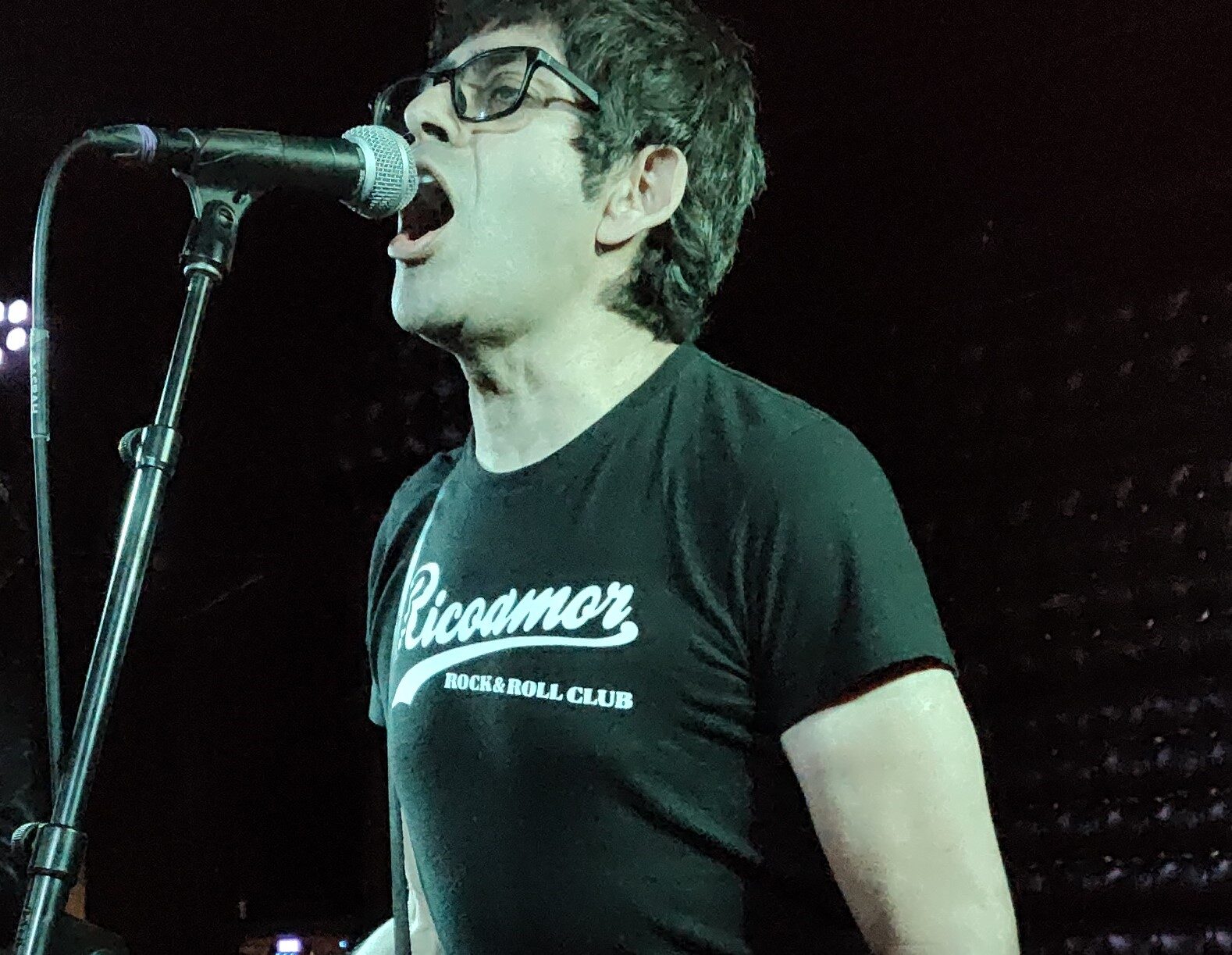
Hector Penalosa is mostly known for being the bassist of The Zeros, but he has also played/plays in numerous bands including the Avengers, the Dragons, F-Word, Baja Bugs, MCM And The Monster, Zeros 77, and has appeared on a ton of albums including the Zeros catalog, Flying Color, and others including several solo albums. He’s always telling me stories whenever I see him, so I decided to have him over to record some of them for history’s sake. After all, he’s been playing since he was a kid and has 6 decades worth of musical experiences to share! We talked for over 3 and a half hours, covering most of his whole career (there’s a lot to cover here!) and we probably could have talked for another 3 hours. I’m splitting this interview into 6 parts, each one being released for the next few Tuesdays.
Part 1 is here.
Part 2 is here.
In part 3, Hector tells a great story about opening for the Clash in 1979, an offer on a Zeros album for Bomp that was supposed to happen in the late ’70s, a little talk about the Zeros documentary (more on that in future parts), and we go into the ’80s with the formation of Flying Color.
Audio in the youTube link. Transcript below it.
Ted: So you rejoin the Zeros back in what ‘79?
Hector: That was summer ‘78.
Ted: And you did a a tour?
Hector: Yeah. And that’s why… that whole car fiasco, led up to getting back into The Zeros, you know, with Baba helping me get back in San Diego. And yeah, we started rehearsing and it was just a three piece at that point. Robert didn’t go back into the band. And then we drove… so we played LA with the Furys. Michael Compton used to be the manager. He was a friend of ours. He went by the name of something like “Jett”. I can’t remember… but that was his punk name. And then we went up to San Francisco and played San Francisco. There was a guy named Ken Friedman there who wanted to manage us. And that’s why we got this summer tour going on. It was maybe four or five gigs. It wasn’t a lot. But Ken came with us on the road. We went to Portland. We played Seattle. Then we backtracked and played San Francisco again and LA again on the way down. And that’s how we got back together. And it was on that trip that we were like, “Oh we got to move to San Francisco!” That was our third time playing in San Francisco.
Ted: And you liked it a lot. More than LA?
Hector: In a weird kind of way, yeah. LA had the record labels and stuff. I guess any intelligent musician would say, “I’m going to stick in LA until I make it.” But for whatever reason, we decided to go to San Francisco and Ken Friedman lived there and he was going to manage us. And so we were like, going to work with him. Years later, many, many years later, Ken Friedman ended up being involved with London Records. And I think he had something to do with the Smiths, if I’m not mistaken. I think he was connected with those guys many years later.

Ted: So when did you play with The Clash?
Hector: That was February, ’79. We were managed by Peter Urban at the time. We also managed The Dils. Chip and Tony Kinman’s band. And Peter wanted to start a group called the New Youth Group, which was basically the reason was to open up an all-ages venue, because there weren’t any San Francisco at the time. He wanted to open up an all-ages venue. He said, “Well, you know, let’s raise some funds. Let’s make some money. Let’s get some band playing.” So there was like this little group of people who got together once a week and talked about the plans, about the New Youth Group. And on one of those meetings… we all knew The Clash were coming to the US and that they were playing at the Berkeley Civic. Bo Diddley was opening. He was the opening act for The Clash. Somebody said in one of those meetings, “I’m going to ask The Clash if they’ll play for the New Youth Group and raise some money. They’ll do a benefit.” And we were all like, “That’s never going to happen. That sounds crazy.” And they said, “Well, I know Paul Simonon and I know, you know, Joe Strummer and blah, blah, blah.” And we’re like I don’t know. I don’t know. Let’s see if this is true or not. (laughs)
And so The Clash come to town, right? And lo and behold, they show up at the meeting. Joe Strummer and Paul Simonon and we’re like, “What the fuck?!” They go “We’re going to help you guys out.” But they couldn’t use the name ‘The Clash’ because they were under contract with Bill Graham. And so there was some clause that said “you can’t play within a hundred mile perimeter of my event.” So they said, we’re going to have to use another name or whatever. So they just… we just took the slogan, “The Only Band That Matters” or whatever was they were calling themselves at the time. And so they played the night before at Berkeley with Bo Diddley opening up. And then the next day we were like, you know the show started happening…
Ted: What do you remember about that?
Hector: It was at a synagogue that became a concert venue. The Temple Beautiful, it was called. And Paul Rat got the lease on that building. It had a huge stage. It was really massive, really big, almost like the Observatory here in San Diego. And lots of gigs happened there. So that’s where the event took place. And Peter organized it. It was Negative Trend, The Zeros and The Clash. And then Negative Trend got all rockstar on everybody and said, “We don’t want to be the opening band. We want to play in the middle.” And we were like, “That’s ok.” What the heck? We were all like “Shit, we are playing with The Clash where we open (play first) or not.” We’re all like, “We’re happy to do whatever.” Okay, yeah, that’s fine. You guys, be in the middle and we’ll open up.
So what I remember was we used to have a friend, Tony Flattop, who passed away years ago, may he rest in peace. We used to call him Tony Zero because he was always hanging out and really loved the band and we’re really close. He had a Volkswagen bug. That day we went to the rehearsal space got the equipment. He always pulled out the back seat and the passenger seat out of the box so we could put everything in there. And then like, I’d climb on top of an amp, we’d go drop off the stuff, you know, at the clubs. And so that day we were like driving over there and we get to the Temple Beautiful. We walk in and there’s The Clash, right? Inside, in front of the stage. There’s no seating or anything. It’s just like this big open, you know, wooden floor space. And they’re kicking around a soccer ball, waiting for the equipment to get built on the stage. You know, the amps and the sound man set up the mics and stuff. And I’m like, “oh, wow, look at that.” And then Tony, my buddy, he just runs in there and starts kicking the ball with the guys! And I thought, “Oh, my God, what the fuck are you doing here?” (laughter) And they were totally cool about it. They would just like kick it to him and they kick it back. You know, they were totally open to that. So that said a lot about the band, you know, to me. They’re pretty cool. They’re pretty cool.
Ted: Yeah, on a couple of levels. The fact that they would even play the gig. A gig that technically they weren’t supposed to.
Hector: Yeah, right.
Ted: On three levels. Yeah. They weren’t supposed to play the gig. Yeah. The fact that they even played the gig. Yeah. Being a big band. I guess they were that big back then, right?
Hector: Oh yeah, they were huge! That was their first time in the US. The first tour of the US. And so I’m all like, okay, you know, I’m going to go to the back dressing room and leave my bass guitar over there in the gig bag or whatever. I walk in there and I’m just sort of hanging out for five to ten minutes. Kind of scoping out the place and here walks in the band, you know, one after another all four guys. Boo, boo, boo. And I’m like, oh shit. And here I am alone with these guys! What am I going to do? And I had a little jacket that had a Sandanista pin. Remember Sandanista? El Salvador…
Ted: The triple album?
Hector: That was way before the album. Okay. But that was the revolution, rebel movement in El Salvador with the Sandinistas and I had this little pin. Their emblem was a red triangle next to a black triangle sort of, you know, one top of the other kind of. And Joe Strummer totally caught it. He goes “Oh, yeah, I really like that pin, you know…” He knew what it was. So, oh, thanks, man. Yeah, you know. And then I was like, oh, so I took it off and said “Here, man. I’m going to give it to you.” And he’s like, “Oh, no, I can’t take it.” And I said, “No, it’s just a gift, please.” So, you know, I’m just being cool, you know, he goes “oh, thank you very much.” And then that was it. And then I left. I was like it’s too much. You know, so I left and left them in the dressing room. Then the show starts, right? I think it was like 3,500 people showed up. It was crazy. It was packed.
Ted: How many people did you play to being the first band?
Hector: To that many. It was already packed. It was already sold out.
Ted: Oh, that’s awesome! Because sometimes the opening band gets the shaft (and there’s no one there)
Hector: Yeah. Well, here’s the funny part. The irony of all of this band lineup was that we went on first. So there’s all these people. We got off stage and then The Clash decided to go in the middle!
(laughter)
Ted: Yeah. That’s awesome.
Hector: They go on. They go play. And then when they’re done and Negative Trend is setting up, it just empties out.
Ted: Oh, my God! That worked out so well for you!
Hector: Well, yeah! I don’t know if The Clash thought maybe that would be a good move to like avoid somebody from the Graham people showing up.. you know, when they’re supposed to be playing, so they play early.
Ted: Wow. Oh, my God. That’s funny.
Hector: It was really funny. I remember that.
Ted: Could you imagine if you were in that middle spot…
Hector: I know. Karma baby. That’s the crazy part.
Ted: So I find it interesting. The Zeros, you had a bunch of singles, but you never had a full length album out until like the ‘90s, which is a good 14-15 years after.
Hector: Well, you know, through time and conversations, I found out certain things.
Ted: Is it something you can talk about?
Hector: Of course. Yeah. Well, apparently when Greg Shaw had given us the opportunity to press two singles, he wanted an album back then. And Mr. Escovedo, Javier Escovedo told him that we weren’t ready. Now, this being back in ‘77, ’78. I didn’t find out about this situation until maybe five years ago.
Ted: Oh, no.
Hector: So yeah, that became a pattern with a Javier where he would make decisions without asking anybody else in the band or not even bringing it up. And it’s like, well, dude… I mean, you know, maybe you don’t want to do it, but maybe we want to do it. And we have to…
Ted: …be a team sometimes.
Hector: Yeah. But unfortunately, that’s the pattern that has existed in The Zeros for many, many years to the point where, you know… there was an interesting question that my friend Anthony Ladesich, who’s actually the director of The Zeros documentary about to come out, hopefully before the end of the year.
Ted: Did you want to jump into that now? I wanted to do things in a chronological order, but if it’s going to flow better…
Hector: No, no, no, you can do chronological. But he did bring it up a while back when we started working on documentary. And it was my turn to get interviewed. He goes, “I never understood. Why have The Zeros never been as big as the Go-Go’s or The Germs or whatever.” And I said, well, let me tell you why, because somebody went out of his way to make sure that wasn’t the case. He understood because through the making of the documentary, he encountered that behavior.
Ted: And that’s why it didn’t happen. I guess you know what, I guess we’ll get back into that in the future when we get… if you have time, are you okay on time and everything? Do you need anything?
Hector: No, no, I’m good. Thank you.

Ted: Okay. We were talking about The Zeros. Greg Shaw wanted to put out an album and it got nixed.
Hector: Yeah. And we didn’t know until many, many, many years later. The same thing when we reunited as a three piece. It was back in, around 2009 when we started playing really actively again.
Ted: You played our bachelor party at the Casbah. My wife and I got married the next day!
Hector: And that’s when Mario Escovedo (Javier’s brother) was managing us for two years. And it was… I’ll tell you: it was the best two years we ever had. Because of Mario. He did an amazing job as a manager. Everything.
Ted: And he booked you some good club shows… I mean festival shows.
Hector: Oh man. He was getting us all those music conferences, you know, like up in Toronto. We did East by Northeast and Iggy Pop was the big name for that three day event. South By Southwest, you know. North by Northwest up in Portland. He was good, giving us of all these high exposure situations. And he was really good with, with guarantees and fair on every level. He was amazing. But, um, yeah, Mr. Javier Escovedo, unfortunately is somewhat self destructive. And it affects the band.
Ted: I guess we might talk a little bit about that now. Why do you think he’s so self destructive? Is it just his personal nature or is he trying to, you know… the punk rock thing would be to take the money while you can, being a bunch of misfits.
Hector: Right…I believe that it’s, uh, it’s more of destructive control rather than no control at all. In the sense that when things start getting really good for the band, I think he feels like he has no control over it. And so if somebody else comes in and wants to make it better, he prefers to back off and take a shit on it, so to speak, and feel that he still has control over it. Remember Snidely Whiplash, do you remember that cartoon character?
Ted: Yeah…
Hector: …with the mustache and top hat and he fucks things up and he goes ha ha ha. And Javier has that kind of personality where he actually gets a kick out of doing that.
Ted: Ahhh…I don’t think he would get a kick out of it.
Hector: Well, I mean, it’s weird, man.
Ted: You would know better than me.
Hector: Unfortunately, it’s been the, the problem for The Zeros not having more notoriety and success. Believe me, we’ve been the luckiest band in the world. Things just fall in our lap…
Ted: Yeah, like the Clash gig…
Hector: The Clash gig… we were opened up for Devo back in ‘77 at the Starwood…
Ted: What do you remember about that show? Sorry I didn’t mean to get off track…
Hector: No no. The band Devo had traveled to Hollywood from Ohio, I believe they were from Ohio. First time around and they were basically just exposing themselves to the LA scene. They had an 8 millimeter screen and an 8 millimeter film camera projector and you know they’re very into their art and all that crazy stuff they did. Immediately everybody liked them because they were just different and wacky and fun and cool and we made friends with them on that first time around. We weren’t best friends, but we told them we liked everything they did and they were cool. Then the second time around when they came out, it was basically because they were signing to Warner Brothers… the second time around they came out to you know do the business end. And they got two nights at the Starwood. I don’t know how we ended up on that bill, but we were the one of the bands. We played both nights.
Ted: Did you meet them? Were they weirdos? Geeks?
Hector: Oh yeah yeah Mark Mark was cool and the other guys were pretty cool guys. We didn’t really bother them much, but they were pretty down earth you know? In fact Mark Mothersbaugh was interviewed for the upcoming documentary. He’s gonna be talking about…
Ted: so that documentary is happening! Ok… we’ll get to that…
Hector: For a moment it didn’t seem like it was,but it’s happening now. Come hell or high water.
Ted: Excellent! (we’ll get to this later) So the albums came out in the ‘90s. What did you do during the ‘80s?
Hector: The Zero’s moved to San Francisco September 78 and by August ’80, we broke up. Practically almost two years later. Javier was like “I’m breaking up the band. I’m moving to Austin”. So he moved to Austin and then Baba stayed behind for a little bit. Baba and I were hanging out. Baba introduced me to this cat named Richard Chase, who was really from Imperial Beach, but he moved to San Francisco. He was amazing guitar player. This guy could play you anything. Like a human jukebox. Seriously. It was impressive! He could play Segovia. He could play West Montgomery. He could play Jimmy Page. you name it. And he was good at everything! I thought “Oh my God! I gotta get better!” This guy is like over there and I’m down here! I gotta get up there. But him and Baba and I started playing together and it was really fun. And then Baba decided “I’m gonna move to Austin too”, so he left. So Richard and I stayed together. We wrote a lot of songs together, about 20 songs during a period of time in there. Then we were like let’s get a band together and see how they sound with a full band. From that we created Flying Color. That was the band I had from ‘82 through ’87. It was a very Raspberry, Badfinger, Beatles, Big Star sounding band. We were very very dedicated to rehearsal schedule to harmonies to everything.

Ted: What did you learnduring that whole period? How to play better or…
Hector: I learned how to pay attention to guitar hooks and melodic hooks and harmonize. I was the bass player and singer too, so I had to do both. And how to listen to your fellow band members when I have ideas. Because Richard had a lot of great ideas and then Dale Duncan came into the band too and he was really great. So the three of us were always pumping out songs and trying out ideas. We were really dedicated. I mean we were tight, you know? To the point where we ended up putting out a single in ‘85 for a little label called Cryptovision out of New Jersey. Dave Amels, was the owner, and he was a musician keyboard guy and he was working for Nady wireless systems in Berkeley at the time. I think they were in Berkeley or Oakland or somewhere, and so he caught wind of us at a gig and he goes I want to put out a single with you guys. And all right, we put out single. And then we went to Tom Allen’s studio. He had a 16 track reel to reel and we did five songs for the 45 and then we would pick the two that we wanted out there. Then Tom Allen liked what he heard, and he said “I’m starting a label called Grifter. You guys want to be the first band on my own label?” You know, put out a full album. And we’re like “What the hell!” Just like that! Then by that time Cryptovision wanted to put out a full album too, so then we had two offers for two albums, you know, and we’re like wow okay. I kept saying let’s do one album with that guy and an album with that guy! What’s the problem? But then Dale was like “oh we should just work with Tom. He’s in San Francisco… blah blah blah” Come on man, what’s the problem? It’d be great to release two records at once! And so we settled for Tom, but then Cryptovision said well if Flying Color won’t put out an album, why don’t you put out a solo album? So it gave me the solo album (laughs). And it’s really a Flying Color record because the drummer and Richard are on that, all over the place. Dale was the only one not on it.

Ted: You said there was three of you working together. Is there a lot of give and take when you have three people like yeah each other (being really good at what you do)?
Hector: Oh yeah. Totally. We make suggestions. We’d be pretty honest and say “I don’t know about that part”. Maybe you may change it or try this or try that you know and everybody seemed to be very open-minded, which is important. Nobody got offended. We all knew we were doing it for common goal.
Ted: I was watching “Get Back”, that Beatles documentary. Paul McCarney’s coming up with a riff and he’s playing riffs and he’s playing… it’s like oh I thought this stuff came naturally to him! I didn’t know he worked at it!
Hector: (laughs) oh yeah, yeah. You got to work at it.
Ted: What did you think of a Get Back documentary?
Hector: Honestly, Ihaven’t really seen it all the way through.
Ted: Really!? Wow, you of all people!
Hector: I’ve been in a Beatle band for the last 20 years. I think this is the last thing I want to do… (laughs) But no, seriously, I will watch it. I will watch it. I hear it’s really great.
Ted: I’m not even the biggest Beatles fan. I mean I respect them. I like them, but watching that I was like oh wow! I’m a fan now! It shows them as real people. it doesn’t show them as these…
Hector: …celebrities
Ted: gods, not even celebrities. Gods. They’re like real people. They’re having real problems. There’s little fights here and there.
Hector: Yeah. They’re a very unique group of guys I mean. They’ve been in each other’s pocket for what 13 years maybe? Lennon and McCartney and Harrison, they knew each other when they were kids you know. They were really little and they were together for a long time and they just grew up out of being a band and that’s why they went solo. I mean at some point you know they have to go in different directions. That’s just normal, I think.
Ted: Which is like with The Zeros and stuff like that. Everyone going separate their separate ways. Robert having El Vez, and you with Flying Color.
Hector: Yeah, yeah, so that’s what happened. I was doing that with Flying Color. And then with Flying Color we ended up putting out the record with Grifter. What happened was Tom Allen… we spent almost ten months making that record, right? It’s a long time. He’s got a 16-track 2-inch, reel to reel and all this fancy equipment and Tom was a stickler, man, a stickler with production. It got frustrating many times because he’d want us to do the same song over and over. I remember one time we got to the point where like we were doing one song 27 takes in a row and I was like “This isn’t going to work. We’re just going through the motions” You know? You got to capture the energy. So then we had a meeting a few days later, the band, and we said okay we got to gang up on Tom and say “Hey we’re gonna do three takes. No more. And take it or leave it.” And we got together with him and he was okay with that. So we were able to get rid of that whole repetitive… and not wasting our time. Tom at the time was also recording Chris Isaacs first album and that’s what was bringing in the money because Chris Issac had just been signed to Warner Brothers. So we had to work around Chris Isaacs schedule because Tom was basically only going to record for free. It was on his dime, in his place, and so we finally got the record done and after spending ten months, and all this you know, if you add all the time that he did and what it amounted to moneywise, I thought that’s a lot of money you know? So I said well how many copies are you gonna press? He goes oh “I’ll start with 1500.” and I’m thinking “Dude! It should’ve taken us 3 months” So then I called Lisa Fancher from Frontier because I knew her, and John, her boyfriend, who ended up managing, I think, Urge Overkill, and a whole bunch of the bands in the future. But I just called him for advice. I wasn’t looking for a deal. I said hey I have questions you know this is what we did and he only wants to do this much units and what should I do? Then Lisa Fancher said “Send me an acetate”. So I sent her an acetate. Four days later she calls me up and goes I want to put this out! I wasn’t going for that, but it happened, you know? And I thought man this is crazy. Frontier already had eight years of being a label and they had I think EIAO and Redd Kross and all these other bands on their label. So I thought, “man this is even better than Grifter”, but Grifter owned the masters because it was on his dime. So I said well you guys got to talk to Tom. Maybe you guys can work a split and then Tom was okay with that. But Tom at the same time had a band called American Music Club and he was the drummer and he had to piggyback his band on our deal. And so what really frustrated me was that we got Grifter/Frontier and American Music Club ended up on RCA. I said “Dude wait a minute. That should have been us, motherfucker” I was pissed. For awhile. I was pissed, but what are you going to do? So yeah, Lisa put it out and she already had experience and connections with all the college radios stations around the country, and said hey I want you guys to wait until all the colleges are back in session so we can give these records to not the substitute DJs, but the ones that are there for the semesters. So we waited and then we did a six week tour of the US and we were supporting the Bodeans, who at that on that tour, somehow they were playing with U2. So when they didn’t play with U2, supporting U2, they had headline gigs and then we’d be the supporting act for the Bodeans. Which is really crazy, and yeah we did that for like weeks.
But with Flying Color we got to open up for the Ventures at the I-Beam and that was like a big feather in my hat because I was a big Ventures fan! I thought “Oh my God, I can’t believe this!” Then we opened up for Smokey Robinson in Missoula Montana at the University! (laughs)

Ted: Any memories of the Ventures and any memories of Smokey Robinson?

Hector: I was just real excited that that you know they were my guitar heroes, you know? I always said the Beatles inspired me to be musician, but the Ventures taught me how to play. I used to play the records. So yeah, I was I was thrilled to be on that bill. I didn’t bother them. You know just kind of shook their hands and said “You are the guys that got me here.” “Thank you”, you know? They were cool.

Ted: I guess this leads me to another question I was gonna ask later, but I’ll ask it now for the flow of things, but you don’t seem to get starstruck.
Hector: No because… I do but I don’t. I do, but I hide it well. That’s what I do. They probably get that all the time. I don’t want to be that person that going “aaahhh!”
Ted: I can tell your enthusiasm when you’re telling the stories…
Hector: oh yeah I know I got to play it cool, because I think (unintelligible) appreciate that more because yeah they don’t want to feel like “oh my God this guy’s…”
Ted: What would you do if you ever met Paul McCartney?
Hector: ahhh… I can’t say it on recorder. (laughs) But seriously, no, that would be amazing. I did meet his son, James. He played at the House of Blues way back in 2012 and he didn’t even play the main stage. He played one of those side off rooms. When the Reader was getting printed back in the day, I saw way at the bottom in the tiniest letters “James McCartney on a Monday night” and I’m like what the fuck? This is Paul McCartney’s son and there’s practically no advertising. So I went there. A hundred people were there. And he had the most amazing band. I mean that kid can play. Obviously, yeah his dad’s McCartney. Great songs, playing piano on one and guitar on the other, you know just rocking out. He was very humble. Did a meet n’ greet. Of course it was all these people with Beatles items. He’s not even in the Beatles for cryin’ out loud! What are you drinking there?
Ted: This is a Hamilton West Indies blend. You want some?
Hector: I’ll try a little bit okay. Just a little shot. Yeah that’s fine thank you.
Ted: Just sip it. Wet your lips with it. It’s a little overproof.
Hector: Delicious. Pretty yummy. Thank you. Then he played again at the Coach House in Saint Clemente but it was just him with an electric guitar. I expected the whole band. We met him there as well then. Nico and I took pictures with him and I told him “Man I really really love your music. I really dig your CDs.” And he was so humble, you know, it was crazy, this kid and he goes “Really?!”
Ted: Did he know who you are? You’re a fellow musician, so you know what you’re talking about.
Hector: No, I was just a fan there. And he really was surprised by that. I mean think about that. Your dad’s Paul McCartney. How does that requite your existence?
Ted: Do you think his talent is hereditary or you have to learn it?
Hector: I think he absorbed it to a degree. I mean being around his dad during recording sessions of Wings or whatever you know? Because he took the family on tours and at one point. They were touring with him, you know. I think that had a lot to do with it…
Ted: It does take work…
Hector: …and also I mean take into consideration that Paul’s dad was a musician in the ‘20s and ‘30s. He was in like a sort of swing band thing in England. So yeah the music sort of runs in the family.
Ted: Wolfgang Van Halen says when people ask him if he was intimidated playing guitar, he goes “Fuck yeah! My dad was Eddie Van Halen!”, but you know what he can do it. Maybe it is hereditary. I don’t know.
Hector: Speaking of Beatles kids, I’ve seen Danny Harrison twice and I saw him at the Casbah, of all places, and it was amazing. The ticket price was worth every penny, because he had his dad’s guitars onstage. Which was crazy.
Ted: You would have paid that just to see that even if he didn’t play!
Hector: What the fuck! He’s got the rocky guitar and the fucking Hard Day’s Night twelve string over there. The Rickenbacker… You’re like “HUH!?” It was like fuck, this is cool. I saw him at the Belly Up and both times he was really great. Yeah I really like the Beatles kids. I call “Here Comes The Sons” (laughter). They’re all great in their own right. I have all their CDs. They’re the continuing legacy of the Beatles and whether you like it or not. One thing I noticed was that a lot of the really older Beatles fans who were teenagers when the Beatles were around the early ‘60s, they don’t really acknowledge the kids. I think it reminds them that “Hey, I’m old” I think that’s what it is. I’ve asked many Beatles fans at the Beatle fair or those Baja Bugs gigs. “Have you heard any songs?” No. “Have you listened to James McCartney” No. “Why? You don’t know what you’re missing, man.” They’re great! They’re really catchy tunes. Really great songwriters. But anyways enough of that… Enough of the Beatles.
Ted: We’ll get back to that later
Hector: We got to come together.
(laughter)

Leave a Reply